Showing posts with label New Novelists. Show all posts

Tuesday, September 27, 2011

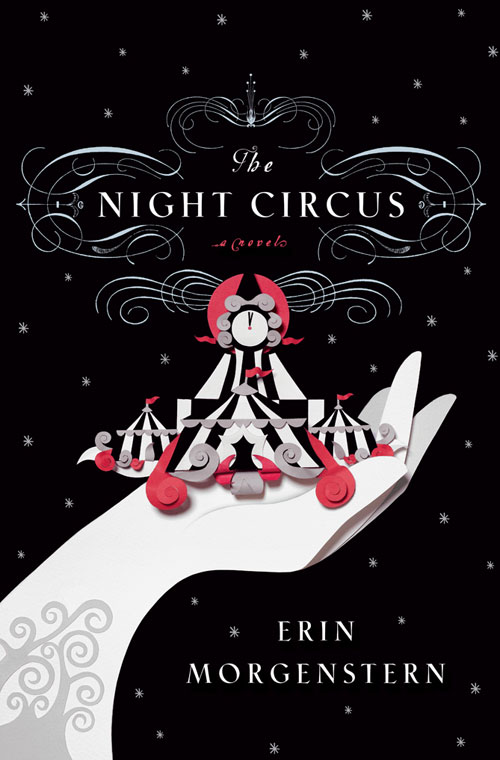
The Night Circus by Erin Morgenstern

The Night Circus by Erin Morgenstern is a fantastic debut novel by a writer to watch.  While not a perfect novel, it ranks high on my list for the year.

The novel opens beautifully:
The circus arrives without warning.  No announcements precede it, no paper notices on downtown posts and billboards, no mentions or advertisements in local newspapers.  It is simply there, when yesterday it was not.
The book is about a contest between two illusionists who have been trained since childhood by their masters.  Set in the late 1800s and early 1900s, the players, Celia and Marco, spend their lives battling in a game, the rules of which they do not know.  The forum for the contest is a circus, Le Cirque des Reves, a travelling circus that opens at nightfall and closes at dawn.  Celia's father, a famed illusionist, takes custody of her as a young child and trains her for this contest.  Marco is plucked out of an orphanage and trained by a mysterious man.  In the circus, they create magical (not slight of hand) illusions that dazzle attendees.  The contestants know they are in a contest but don't know each other (for at least a while) and are inextricably bound to each other.  Over the course of the novel, they learn about themselves, the contest, others affected by the contest and each other.

The writing beautifully captures the magical and ephemeral quality of the characters' existence.  The novel jumps through several time periods and to many different locations, further creating the feeling of an illusion.  The chapters are well constructed, not too long, and full of movement.  At no point does Morgenstern wander into long (or short) boring narratives.  Morgenstern is a painter, and her novel feels like it is a painting.  She masterfully employs color to create moods.

Where the novel came up a bit short is at the ending.  It was good and brought closure but it lacked the richness that filled the rest of the novel.  In an interview, Morgenstern said that creating scenes and images are her strength, not plot.  For a debut novelist, she admirably handled all of it but the plot came up a bit short  at the end.

Usually, I do not love "magical realism" books.  This is an exception.  The advance buzz for this book was immense; the novel held up to expectations.  Comparisons have been drawn to Harry Potter, Twilight and other magical universe books.  I would recommend reading this book.  It is enjoyable and will be the first of many from Morgenstern.


The book preview:

An interview with the author:

Wednesday, May 4, 2011

Bright Before Us by Katie Arnold-Ratliff

Bright Before Us is a first novel by Katie Arnold-Ratliff, published by the literary house, Tin House.  With this novel, Arnold-Ratliff, an assistant editor at O, The Oprah Magazine, forcefully enters the literary world.

The novel's narrator, Francis Mason, is a twenty-something, progressive second grade teacher in San Francisco.  On a field trip to the beach with his class, Mason discovers the body of a suicide victim.  The trauma of the experience unravels Mason, who becomes lost in memories of his childhood love, Nora, who lost her parents in a car accident, and forces him to contend with marital unhappiness and anxieties about his wife's pregnancy.  Mason rapidly unhinges and becomes slightly paranoid, mixing reality and fantasy, while he contends with choices and understandings about love and loss.  Mason ends up on a road trip (see a cool map documenting the trip that Arnold-Ratliff put together here) and addresses his fears.

While Arnold-Ratliff uses simple and approachable language, there is nothing simplistic about this novel.  Arnold-Ratliff paints a vivid and believable portrait of San Francisco (an excellent choice of back drop for this novel) and paranoia.  At one point, Mason's paranoia becomes so intense that the novel begins to feel more like a murder mystery than a literary novel.  Arnold-Ratliff effectively switches narrational approaches in each chapter as a way of marking two separate but interlinked story lines.  The risk with a novel that explore the inner-psyche of its characters is that the plot stagnates (if there is one at all).  Throughout the novel, Arnold-Ratliff maintains authorial command and convincingly propels the narrative forward. 

I approached this novel with an open mind, was immediately engaged and could not put it down.  I was pleasantly surprised by how caught up in Mason's character I was.  Bright Before Us is a thoughtful and worthwhile book, which I would recommend reading.

For an author interview, click here.

If you happen to collect books (and not just read them), Powell's terrific IndieSpensable program is featuring this title in a special printing as its current installment.  Click here for details. (No promotional consideration received for this endorsement).

Thursday, April 14, 2011

The Tiger's Wife by Téa Obreht

The Tiger's Wife by Téa Obreht, a 25 year old, first time novelist, is one of the most anticipated books of 2011.  Ms. Obreht was included as one of the New Yorker's 20 Under 40 last spring without having published any novels or short story collections.  (Seems a bit like President Obama winning the Novel Peace Prize shortly after being elected to office.)  Talk about pressure. 

The Tiger's Wife justifies the pre-release attention Obreht garnered.  The novel is a stunning debut and is the launching point of a career to watch.  While the book is not perfect (I'm not sure of one that is), it is a sensuous read and worthy of staying up to read.

The story revolves around Natlia and her grandfather both before and after the disintegration of Yugoslavia (although the country is unnamed in the book).  Natlia's grandfather passes away far from home while Natlia, a doctor, is on a humanitarian mission to provide services to orphans.  Natlia tries to find answers about her grandfather's death while keeping secrets from her grandmother about what she knew and when she knew it. 

In parallel, Obreht takes us back to the grandfather's childhood in the 1940s.  During the war, a tiger escapes from the zoo and seemingly develops a relationship with a deaf-mute woman, who has abused by her butcher-husband.  During the grandfather's life, he meets the "deathless man," a symbol for death, who crosses paths with the grandfather and Natalia over the years.  The tiger's wife and the deathless man are fables that intersect with life and test the characters.

The first pages of the novel lulled me into thinking this would be a literary book that develops slowly.  Suddenly, Obreht throws in rapid action; and the novel unfolds.  My critiques, minor as they are: the book has multiple plot lines that have to be tracked carefully.  After the dramatic opening, the novel slows down a bit and takes a while for it to pick up again. 

Obreht's writing is rich and breathtaking. She juxtaposes beauty with devastation and companionship with loss. Obreht draws on her formative years in Belgrade and uses the novel to cope with her loss of her grandfather.  It is a magnificent work.

Read Obreht.  She deserves the accolades.  I would be surprised if this is not the winner of a prize or two this year.  The reviews have been deservedly glowing.

Other reviews: NYT, The Magic Lasso, The Devourer of Books (they all loved it).

Thursday, April 7, 2011

The Free World by David Bezmozgis

Many books have been written about the immigrant experience: the need to leave a land, the difficulty of assimilating into a new culture and the challenge of preserving identity.  David Bezmogis, a New Yorker 20 Under 40, uses his new and first novel, The Free World, to tackle the story of the Soviet Jews. 

The Soviet Jews that were released in the 1960s and 1970s could not travel directly to Israel or the US.  Often, they stopped over in Vienna or Rome en route to the free world.  The stop over could take days, weeks and even months.  (For a fantastic non-fiction book on Soviet Jewry, click here.) 

Bezmozgis' story opens in 1978 with the arrival of the Krasnansky family in Rome.  The familial patriarch, Samuil, is an old Communist and Red Army veteran, who reluctantly leaves his home and life.  His wife, Emma, reconnected with her spiritual heritage in the Soviet Union.  Although she is only a supporting character, she displays a sharp understanding of her family and their problems.  Their eldest and pragmatic son, Karl, arrives with his wife and two boys.  His muscled physique and opportunistic outlook lead him into the underworld of Rome.  The younger son, Alec, a bon vivant and womanizer, arrives in Rome, with his new, scandalously acquired bride, Polina.

The family tries to find its way through the maddening bureaucratic maze of Rome, while struggling to survive and understand why they left.  On the way, they find other former Soviet Jews and develop interesting connections.  Throughout the novel, Bezmozgis takes us back into the characters' colorful histories, developing who they are and why they left. 

Bezmozgis was born in Latvia. Like Gary Shteyngart (Super Sad True Love Story and Absuridstan), Bezmozgis's writing is biting and sharp witted.  His use of the English language is shaped by the rhythm of the English as it translates into Russian.  As he said in an interview:

I usually thought about what the conversation would be like in Russian and then would translate it into English. If there was something ungainly about it, then I’d try to correct for it. There are certain words where, if I had a choice between that and some other English synonym, I’d consciously use the one that’s more Russian. My belief is that it will be transparent enough for an English speaker, but if you’re a Russian–speaking reader and you can translate backwards, there are certain nuances that will come through.  Full Paris Review interview here.

The novel has a great rhythm and pace to it.  Bezmogis intersperses humor and tragedy through the book, while meaningfully and thoughtfully exploring his characters.  It is a beautifully written book.  My only critique is that he drops in several dialogues in Italian, which are distracting.  Otherwise, I enjoyed this book and would recommend it.  If you liked Shteyngart, you should read Bezmozgis.  Both deserved their New Yorker 20 Under 40 status.


Other reviews: Largehearted Boy, NYT and The Millions.


Tuesday, March 15, 2011

Heresy by S.J. Parris

Heresy, An Historical Thriller, by S.J. Parris, is the first novel in a new mystery series set in 1583 in Oxford, England.  At the center of the novel is Giordano Bruno, an Italian monk excommunicated by the Roman Catholic church.  Bruno, a street smart philosopher, finds his way to England and seeks refuge there to spread his more tolerant religious thinking.  Bruno is invited to speak at Oxford.  En route, he is recruited as a spy by Protestant Queen Elizabeth's secretary of state to report on underground Catholic activities in Oxford.  As an excommunicated Catholic, the Queen can trust him; but as a Catholic, he has access to people and meetings that Protestants will never manage.  At Oxford, several people die and Bruno, the outsider, is thrust into the role of detective. Parris loosely bases her protagonist on the real monk and philosopher, Giordano Bruno

The historical novelist faces two challenges: creating a believable setting and telling a good story in that setting.  Parris succeeded at creating a realistic and detailed back drop with characters that have real flaws.  Although the story shows terrific promise and generates intrigue and tension, it ends a too melodramatically and fizzes out by the end.

Recommendation:  If you want the very best in historical thrillers, I'd first recommend CJ Sansom and David Liss.  Parris is an up-and-comer with good potential.  Her newest novel, Prophecy, is due out in the U.S. in early May.


Other reviews: From the TBR Pile and S Krishna's Books.  Both are lukewarm.  
 
Author interview:

Monday, March 7, 2011

Book Review - The Fates Will Find Their Way by Hannah Pittard

Hannah Pittard's first novel, The Fates Will Find Their Way, is a fascinating concept novel.  Pittard is an accomplished short story writer.  In this novel, she creates a well-paced narrative and effectively uses interesting storytelling techniques.

On Halloween night in a mid-Atlantic state, sixteen-year-old Nora Lindell disappears.  This is how the novel assertively opens: "Some things were certain; they were undeniable, inarguable.  Nora Lindell was gone, for one thing.  There was no doubt about it."

The story then develops into a Choose-Your-Own-Adventure, spinning out possible narratives of what might have happened to Nora.  (She probably did this, she might have done that.)  The possibilities of what might have happened to Nora are told and then retold, carrying the novel forward.  While the grammatical form is a little unfamiliar in a novel, Pittard manages it very well.  In parallel, Pittard tells the story of what actually did happen to Nora's sister and father and the community in which they all lived. 

What makes the novel even more interesting is that it is written in the first person plural.  The narrator is a group of boys who were Nora's classmates.  The "we" are intrigued by Nora's teenage sexuality and, for the rest of their lives, the boys wander aimlessly through marriages, divorces, crimes and death still in the clutches of Nora and what might have been.  Pittard nailed the group voice.  If the first person plural is of interest to you, you should also read  Joshua Ferris' hysterical (and yet sad) examination of office life in Then We Came to the End.

Recommendation: The mix of the first person plural voice and the choose-your-own-adventure approach to the novel makes it a refreshing and inventive book.  Pittard expertly develops the story like a carefully crafted kaleidoscope.

Other reviews: Book Lady's Blog, Devourer of Books, Shelf Love and Book Sake.

Interview with Pittard here.

The publisher's discussion of the book:

Tuesday, February 22, 2011

Mr. Chartwell by Rebecca Hunt

Winston Churchill was the greatest statesman of the twentieth century and certainly belongs in the pantheon of the greatest leaders of all time. His leadership saved England and the free world. 

One of the lesser known facts about Churchill is that he suffered from depression. He called his depression his "Black Dog" and often wrote about visits from the Black Dog.  In the new novel, Mr. Chartwell,  first time novelist Rebecca Hunt presents the intriguing idea of incarnating Churchill's depression as a black dog named Black Pat

The novel is set in July 1964 on the eve of Churchill's retirement from Parliament.  Black Pat, a six foot black dog, visits Churchill, lays across him literally to weigh him down, chews rocks to annoy Churchill and engages in other assorted slobberingly doggish and childish behavior.  Black Pat also attacks a young widow, Esther, who rents a room in her home to him.  She too must battle with Black Pat.

Part of what made Churchill so famous was his use of language.  He was famous for his sharp quips (Lady Astor: "If I were married to you, I'd put poison in your coffee." Churchill: "If I were married to you, I'd drink it."), his inspiring speeches (see below) and his mastery of language (see forthcoming post on Churchill works and bios).  Take away the cigars, the house (named Chartwell), and several other details about setting, and Hunt's Churchill is no more than a cantankerous old man. 

Recommendation: I'd recommend passing on this novel. While the writing is good and the concept was interesting, the execution lacked.  Embodying depression as an annoying dog did not work.  Also, without Churchill's distinct and powerful voice, the novel missed the mark.

Other Reviews:
Follow the Thread, Lovely Treez Reads, and Chick With Books.

Thursday, February 10, 2011

Swamplandia! by Karen Russell

Swamplandia! is the much anticipated first novel by Karen Russell.  This is one of the big literary entries for the year.  The story is the outgrowth of one of Russell's short stories from her collection, St. Lucy's Home for Girls Raised by Wolves.  She is a 29 year old writer and was selected in 2010 as one of the New Yorker's 20 Under 40 and previously by Granta, a British literary journal, as one of the Best Young American Novelists

Swamplandia! is the name of the Florida Everglades alligator theme park, which is owned and run by the Bigtree family.  Chief Bigtree, the patriarch of the family, poses as a Native American tribesman and creates a history and corresponding museum based on it.  The family consists of the Chief and his wife, Hilola Bigtree, and their children, Kiwi, Osceola and Ava. 

As the novel opens, we watch Hilola Bigtree, a renowned alligator wrestler, perform her legendary act: diving into and swimming through a pit of crocodiles.  Hilola transforms from a doting mother into a larger than life performer.  Several pages later, Hilola dies from ovarian cancer, and without its headline act, Swamplandia! must compete with a new corporate theme park, World of Darkness.

The family silently struggles with Hilola's death, ever mounting debt and the shattering of their mythic existence.  The Chief escapes to the mainland to search for investors to reinvent the park.  Kiwi, the eldest son, flees the swamp to earn a high school degree and take a low wage job to save the park.  His struggle to integrate into mainland teenage life, having grown up in the cloistered swamp, provides a welcome diversion.  Osceola is carried away on a spiritualistic journey, falling in love with the spirit of a deceased depression-era swamp dredger.  Ava, with an interloper known as Bird Man, tries to rescue her sister from the underworld, where Osceola has gone with her spirit boyfriend.

The narration alternates between Ava (in the first person) and Kiwi (in the third person), but this is Ava's show.  Although she is only thirteen, Russell presents Ava in a highly sophisticated and developed manner, not simply in the voice of a young teenager. 

Russell's writing and word choice are powerful, precise and vivid.  ("Ghosts silked into our bedroom like cold water." "...a hog-necked man with a high Sunday collar, his eyes a colorless sizzle like grease in a pan, half his face erased by the dark barn.") She has a sophisticated mastery of language and successfully paints a magical and mythical picture of the Bigtrees and the Everglades

Recommendation:  Russell's use of words and sentence construction are worth reading by themselves.  It is high impact writing.  She is a writer to watch, and her accolades are well deserved.  If you want a book that moves or is plot driven, pass on this.  This is neither an easy book to read nor one that moves quickly. 

Other Reviews: Nomand Reader and Mookes and Gripes.

Click here for a recent NPR interview with Karen Russell.

A reading by Karen Russell from her short story collection.

Thursday, February 3, 2011

Major Pettigrew's Last Stand by Helen Simonson

Major Pettigrew's Last Stand is a delightful first novel by Helen Simonson. Major Ernest Pettigrew is the quintessential Englishman, stodgy, prudent, understated and, above all, proper. The death of his brother sparks an unexpected friendship with Mrs. Jasmina Ali, a Pakistani shopkeeper in the Major's English countryside village. Their relationship grows from their shared love of literature and the loss of each of their spouses.  The Major, a respected and deeply rooted member of village life, must deal with the small-mindedness of the villagers.  Ms. Ali struggles with the religious shackles of her family and the villagers' treatment of her as an outsider. The Major also must confront his relationship with his superficial and materialistic son, the London banker, who has left village life and the values of his father.


The novel is loaded with conflicts: intergenerational, cultural, religious, societal and modernization. Simonson beautifully sets the story in the quiet village and paints a convincing portrait of life in the village without becoming farcical or contrived.

What I love about the Major is his strugle.  He is firmly grounded in "old fashion" values ("In my day, respect was something to strive for. Something to be given, not taken."), yet he is impulsive and irreverent. Simonson has fun showing us how he reconciles his dualing sides. 

The major themes of the novel are not new – does love conquer all and can people get beyond their own cultural shackles? What’s fun is the setting and how the characters develop in this timeless novel. It is an optimistic and worthwhile read.

Recommendation: This is a great book club book and an otherwise fun, easy read. The themes and issues are universal and relevant. The story is accessible and worth the read.

Below, the author discusses her book.


On a separate note, I want to welcome the blog's many new readers.  I'm very excited to have the opportunity to share my thoughts with you and would love to hear any feedback.  Thank you for coming on this adventure with me.

Monday, January 31, 2011

You Know When the Men Are Gone by Siobhan Fallon

Great novels expose us to ideas, places or experiences that we may not otherwise know about or have the ability to access.  The new novel, You Know When the Men Are Gone by Siobhan Fallon, is eye-opening and a must read for anyone who wants to understand what it means to live a military life.

In 2001, when the armed forces were sent abroad to fight our wars against terror, the families of our armed service professionals were left behind--left behind to raise their children, deal with their illnesses and manage the day to day challenges of family life.  Alone.  Loneliness and longing envelop everyday existence.  Then, when the professionals come home, the reunions are often challenging.  A sign by the gates of Fort Hood warns, "You've Survived the War, Now Survive the Homecoming."

This series of loosely interwoven short stories was eye opening for me.  In one story, a woman must deal with her husband's infidelity.  In another, a cancer patient must deal with the results of a critical test and an unruly teenager.  In another, a warrior can't speak about the atrocities he has seen.  Finally, in one that I certainly can relate to, a New York City investment banker stoked with the idealism of fighting for freedom leaves his home and profession to enlist. 

The stories are compelling and piercing.  Fallon does not sensationalize the tragedies and challenges.  She expertly takes us into the lives of the soldiers and their families and friends and shows us the costs and burdens of our wars.  The writing is terse and loaded with tension.  While the stories themselves made me question whether we do enough for the soldiers that are deployed to protect our freedom, Fallon does not offer political views.  The stories speak for themselves.

Recommendation: I really enjoyed this (and I did not expect to).  It is a short and easy read but very powerful and compelling.  It will leave you sharing the families' sadness and wondering whether we do enough for our veterans


Author interview below.


Other reivews:
NPR

Monday, January 24, 2011

The Serialist by David Gordon

The Serialist is a fun and witty first novel by David Gordon.  The book has been nominated for an Edgar Award for best first novel of the year.  It is a great read.

Harry Bloch is a struggling author of mysteries, vampire stories and pornographic tales, all under pen names.  A serial killer on death row approached Harry to ghost write the killer's memoirs.  After several meetings, people Harry interviewed for the memior turn up dead, killed in the same signature style of the serial killer.  Harry is immediatly the prime suspect.  To protect himself, Harry is forced to become an unwilling detective.

For anyone who likes mysteries, especially noir mysteries, this is a terrific new voice.  The novel is loaded with references to great mystery authors and characters such as Edgar Allan Poe, Sherlock Holmes, Agatha Christie, Dashiell Hammett's Sam Spade, PBS mysteries and several others.  The voice is strong and distinct.  The plotting and pace will keep you reading.  Although this is written in the tradition of hardboiled private investigators, Gordon modernizes the characters and the issues.

Recommendation: This page turner is worth a read.  You'll read it quickly on a long cold afternoon or on the beach.  For hardboiled mystery enthusiaists, it is a must.

Author interview here.

Saturday, January 22, 2011

The Report by Jessica Francis Kane

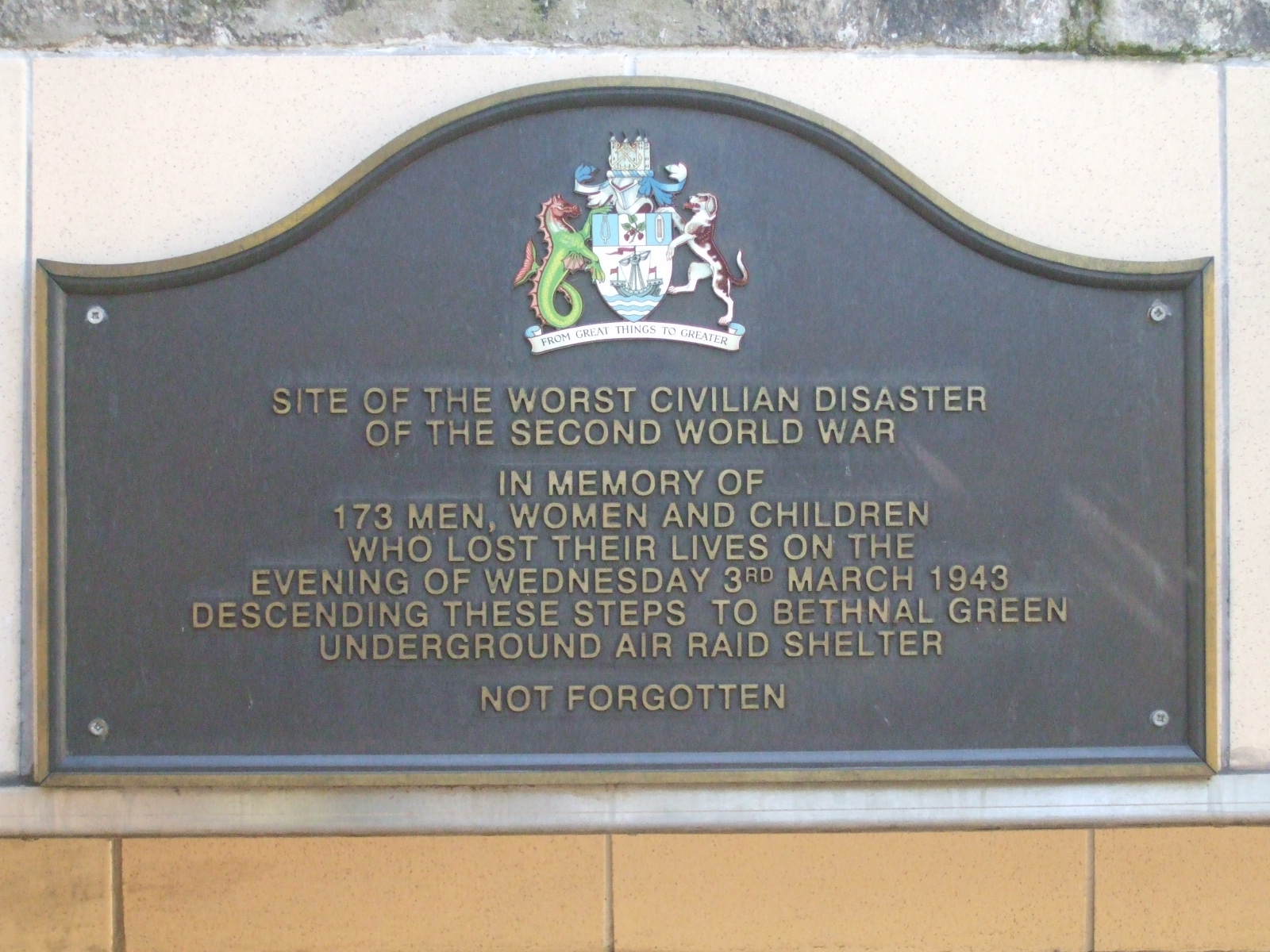
The Report is Jessica Francis Kane's first novel.  During WWII, Londoners regularly spent nights in London Underground Tube Stations that were transformed into bomb shelters.  In March 1943, 173 people died in one of those shelters.  No bombs fell that night.  It was one of the worst civilian disasters in London during the war.

The novel is based on this true story and tells us how an East London community suffered through and managed with loss.  In response to a public outcry, a respected magistrate is tasked with writing a report to determine the cause of these deaths.  In the process, he is forced to make difficult judgments.  In a parallel story, a young documentary film maker visits the magistrate to interview him for the 30th anniversary of what was a ground breaking report.

The Report questions hindsight and the revisiting of mistakes.  We have lived through and learned from many of these reports (e.g., The 9/11 Commission Report, The Space Shuttle Challenger Report). At times, they seek to assign blame and at other times they try to teach or simply explain. The book is part of a growing collection of post-9/11 literature that struggles with communal loss and asks questions such as "when engaged in a war, is morale more important than reason?" and "is truth always a noble end in and of itself?"  Kane expertly poses these questions.

Kane provides us with insight into an aspect of WWII that I had not read much about before: how did the war affect the daily lives of Londoners?  She examines the sacrifices they were forced to make.  Although this is a period piece, Kane frames the story in a way that makes the appeal far more universal.

Recommendation: This is a very good book and worth the read.  In this well paced piece, Kane combines excellent literary writing with important universal questions.


The memorial plaque from the station.


Other reviews
Full-Stop.net

Thursday, January 20, 2011

Review -- The Sherlockian by Graham Moore

Graham Moore's debut novel, The Sherlockian, was good for so many reasons.  Since I was a child, I have loved Sherlock Holmes.  As an adult, I found the world of Sherlock Holmes scholars in which Sherlock Holmes was real and the inconsistencies in the stories provide endless fodder for scholarly articles and debates.  Half of Moore's novel is set in the world of these obsessive scholars.  At a society meeting, a long lost diary of Arthur Conan Doyle (the creator of Sherlock Holmes) is discovered.  The man who has spent years trying to locate the diary is suddenly found dead on the eve of presenting his findings to the society.  The newest member of the society begins a Sherlock Holmes worthy search for the murderer.

In parallel, Moore tells us the story of a murder investigation conducted by Doyle himself with his sidekick, Dracula's creator, Bram Stoker.  Moore expertly sets this narrative in late Victorian Britain. 

In 2004, the New Yorker published an article about the mysterious death of a Sherlockian scholar, Richard Lancelyn Green.  Moore used that basic story to create the first part of his narrative.  One of the enjoyable parts of this book is how fact and fiction meld, which is exactly what happens in the world of Sherlock Holmes today.

As a Sherlock Holmes fan, I loved the book.  Moore faithfully references the Sherlock Holmes stories (also known as "The Canon") without shmaltzing up the book with all of Holmes' catch phrases. 

The book has appeal to any lover of mysteries, not just Sherlock Holmes enthusiasts.  It has garnered several terrific reviews already.  I am looking forward to Moore's next work.

Great Reads from 2010

A Visit from the Goon Squad by Jennifer Egan.  A fantastic book which is a a series of freestanding short stories that together create a novel. The writing is magnificent and highly readable. Egan experiments with new forms, including an entire chapter written in a Microsoft PowerPoint presentation.  The New York Times selected it as one of the five best fiction books of 2010.  Her PBS interview is below.


Room by Emma Donoghue.  The voice in this book is powerful. It is the story, told from a child's perspective, of a boy and his mother being held captive in a room. The child (our narrator) is born in captivity and believes that this room is the entire universe. His mother creates an entire world for him and through him we see her stength and power. It is impossible to put this one down.  It was one of the 2010 Man Booker prize finalists.  The book trailer is below.


Freedom by Jonathan Franzen.  This was labelled as "THE" book of 2010. It made a huge prepublication splash, helped by Franzen's appearance on the cover of Time and photos of President Obama with a reviewer's copy on his Martha's Vineyard vacation.  Franzen is an incredible writer. The book lived up to the hype. The story itself is about a Midwestern family and the concept of freedom. It is very hard to summarize the plot but trust me it is a great book.  A recent interview with Franzen is below.  He comes across as reserved.  The writing is anything but.


The Imperfectionists by Tom Rachman.  This was one of my favorite finds of the year.  In each chapter, Rachman tells the story about different people connected to a struggling Roman newspaper printed in English.  The characters are imperfect and their struggle is great to read.  I'm looking forward to his next book.  Rachman should have a bright future.  The NYT review was one of the first and could not have been more generous and dead on.


The Millennium Trilogy by Stieg Larsson.  If you haven't read these (The Girl with the Dragon Tattoo, The Girl Who Played with Fire and The Girl Who Kicked the Hornet's Nest), you have missed the publishing phenomenon that rivals Harry Potter.  Larsson was a Swedish writer who died young, leaving these manuscrips behind.  These books have become a literary sensation worldwide and have been mainstays on every bestseller list throughout 2010.

These are thriller mysteries. The writing is fine.  What makes these amazing is the storytelling.  Larsson packs a lot of punch in these books. In these books, Larsson attacks Swedish society, the abuse of women, sexuality, technology and the freedom of the press.  If you haven't read these, you should.  They are great beach / long winter night reads.

The Dragon Tattoo is a free standing book.  The last two continue with the same characters but are really just a single story.

There is a fourth manuscript that exists but it is stuck in litigation between Larsson's family and his long time girlfriend.  NYT story here.  The Swedish movie trailer is below.


Super Sad True Love Story by Gary Shteyngart.  This is a satirical look at life in the near future.  China runs the world.  People are attached to the network, constantly monitoring their coolness factor and credit rating.  It is an excellent book and hysterical.  In June 2010, Shteyngart was named one of the top 20 writers under 40 by New Yorker.  Book trailer below.